


Hangzhou: Indexing China's Urbanization
Mathieu Borysevicz, a visual artist/filmmaker and writer whose photography-based projects often take shape as massive billboards, has lived in China on and off for the last 14 years. Formerly working in Beijing, the country's first contemporary arts center, and now in Shanghai, he has created a photographic index of China's frenzied rush to modernity.
He adopted the city of Hangzhou, the heart of the Yangtze River Delta, which is one of the fastest developing regions in the world. Here he discovered a microcosm of the many sides of China's urbanization. Between 2003 and 2007, he shot thousands of images based on repeating patterns in urban phenomena such as high-rise construction, Disney-esque private dwellings, advertising images, construction barricades, and internet bars, to name a few.
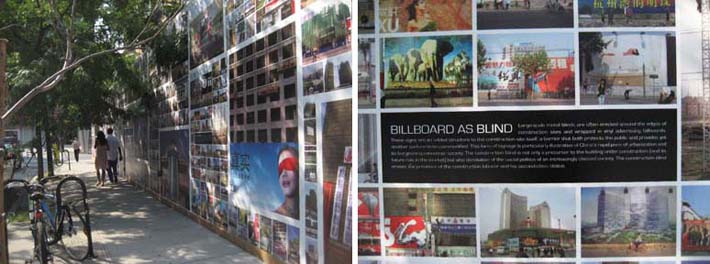
"Hangzhou is one of the cradles of Chinese civilization, dating back some 4700 years," says Mathieu. "While downtown Hangzhou is centered around the picturesque and
idyllic West Lake historic district," he continues, "the backside of the city unravels in a spirit of anarchic ecstasy, with no adherence to architectural stylistic integrity or regulations regarding
size, signage, or zoning."
From now until mid-September, visitors may read Mathieu's visual and verbal findings as a
giant billboard brought down to earth. Chapters from Learning From Hangzhou, the title of this project (originally
conceived as a book) have been transformed into a construction barricade that enfolds Storefront for Art and Architecture during its reconstruction. It's as if New York has been presented with a
public reading wall, much like the public newspaper reading walls that can still found in China.
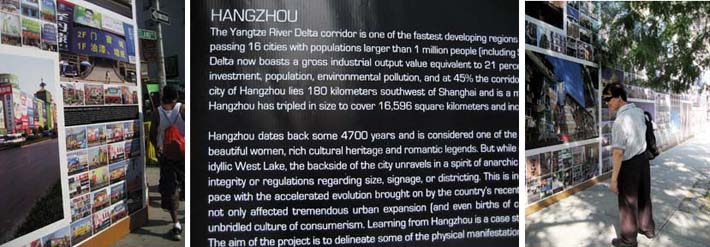
Photographs by Peggy Roalf
His project borrows its title and cue from Robert Venturi and Denise Scott-Brown's seminal work, Learning from Las Vegas, which examines the implications of popular culture on architectural design. In Las Vegas, signs often become buildings while in Hangzhou, new construction often becomes a support for advertising images for the buildings themselves, leaving the architecture at the service of its own marketing plan. Learning from Hangzhou offers insight on a globalizing world that is increasingly frivolous in the commoditization of its public spaces. The book, a work in progress, includes an introduction by Venturi and Scott-Brown.
Embracing spectacle and visual ecstasy as it unfurled before his eyes, Mathieu Borysevicz presents an appreciation for the China of today, captured here in a moment that will, he says, "quickly vanish into the forgotten lineage of China's amnesiac race toward hyper modernity."
Storefront for Art and Architecture is located at 97 Kenmare Street, New York, NY. Learning From Hangzhou will remain in place until Storefront's inaugural reopening and the presentation of White House Redux, a competition to redesign the ultimate symbol of personal political power, set for September 23, 2008. Please check the website for information.