


Graphic Novels, Comics and History
Graphic novels - a genre that originated just 30 years ago - have entered the cultural mainstream with force. Now the subject of a major exhibition at the Norman Rockwell Museum in Stockbridge, MA, this sequential art and literature form seems to be everywhere.
In an article in today's New York Times about a graphic novel created to teach the history of the Holocaust to German schoolchildren, art critic Michael Kimmelman wrote, "Among other things, the book, building on the obvious precedent of Art Spiegelman's "Maus," shows how far comics have come as a cultural medium to be taken seriously."
At the Rockwell Museum, "LitGraphic: The World of the Graphic Novel," includes the original manifestation of the form, Will Eisner's "A Contract with God," along with contemporary and historic examples by masters of the form. The exhibition continues through the end of May, and is accompanied by a host of related public programs.
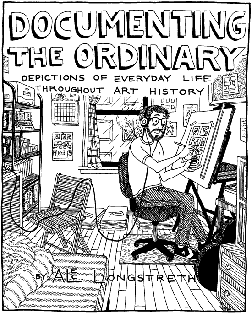 This Saturday, Brooklyn-based cartoonist Alec Longstreth will present
"The Business of Art: Self-Publishing Your Comics." Alec, the winner of a 2005 Ignatz Award for Outstanding Mini-Comic, is currently working on his first graphic novel and his illustrations have been
commissioned by clients such as Nickelodeon, National Geographic for Kids, and Scholastic. He will talk about production, distribution, promotion and invites aspiring artists to bring in their
portfolios for review following the talk, on Saturday, March 1, from 1:00 to 4:00 pm. Please check the website for details.
Illustration, left: Cover of Phase 7, #013, in which Alec Longstreth teaches art history to students at Pratt Institute
This Saturday, Brooklyn-based cartoonist Alec Longstreth will present
"The Business of Art: Self-Publishing Your Comics." Alec, the winner of a 2005 Ignatz Award for Outstanding Mini-Comic, is currently working on his first graphic novel and his illustrations have been
commissioned by clients such as Nickelodeon, National Geographic for Kids, and Scholastic. He will talk about production, distribution, promotion and invites aspiring artists to bring in their
portfolios for review following the talk, on Saturday, March 1, from 1:00 to 4:00 pm. Please check the website for details.
Illustration, left: Cover of Phase 7, #013, in which Alec Longstreth teaches art history to students at Pratt Institute
But first, Alec will make a stop in White River Junction, VT, home of the Center for Cartoon Studies. This "comics college" opened its doors in 2005, offering an MFA degree as well as a certificate course of study. The artist will give his second CCS lecture there on Thursday, February 28, at 3:00 pm.
I caught up with Alec the other day by email to ask about his work and process, in particular his advocacy of the 24-hour Comics Day. He wrote back, "In 1990, Scott McCloud (author of the seminal Understanding Comics) challenged his fellow cartoonist Steve Bissette to draw a 24 page comic in 24 consecutive hours. Both Scott and Steve were known for working slowly, so it was a chance to really cut loose and experiment. It worked great, and Scott made it an Open Dare to the comics community at large.
"Over the years, hundreds of cartoonists have attempted to draw 24-hour comics (I have done 7 myself!) And then at some point a few years ago, someone had the idea to set up a specific day for drawing 24-hour comics. If one wants to draw a 24-hour comic, this is it is a chance for people to meet up (often in their local comics shop) and go through the experience together. But you can also do the Dare on your own. I think it is one of the most amazing creative experiences. It is intense and you end up creating all these things you didn't know you had in you."