


Kandahar Journal
The Afghan Air Force (AAF) MI-35 Hind helicopter gunship sits squatting on the runway in the noonday Kabul International Airport (KAIA) heat. Even with its innards exposed, the Hind still looks threatening. It looks just like the Apache doesn’t. While the Apache looks like a toy, the Hind – even this 30-year-old bird – looks like the grown-up real-deal. It looks like it could take a “young boy’s wish” and crush it. The look is all illusion though. This Hind is a legacy vehicle of the AAF. It somehow survived the fall of the Soviet Union, the resulting civil war, the abuse and abandonment of the Taliban, and the aerial bombardment by the U.S. in response to 9/11.
The man under the cowling of the Hind is First Lt. Dost Mohammad. He has been a maintenance mechanic with the AAF for more than two decades. He is legacy staff — meaning — old school, intelligent, careful and loyal. Exactly the kind of people you want maintaining your Air Force. He has seen it all in his time.
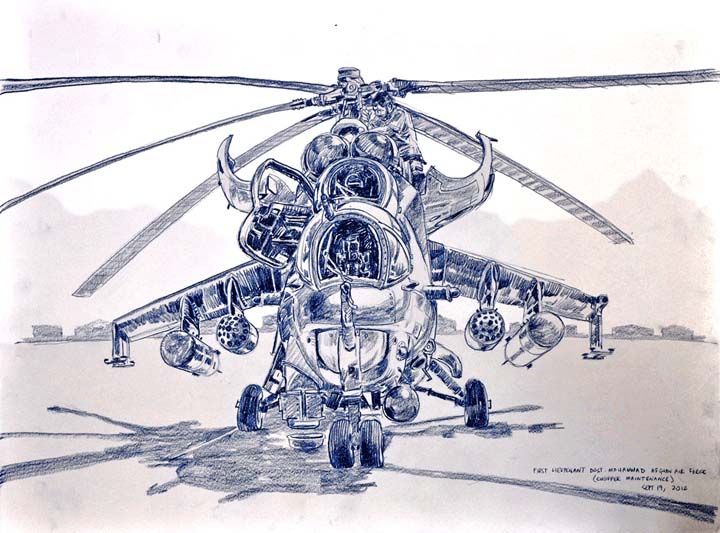
“This chopper has two engines. In one situation, we had an engine failure. On one engine you have to land quickly. We had to throw things of the vehicle to reduce weight. We dropped the fuel tanks and weapons and threw the baggage out the door, we landed hard – I felt lucky to still be in this world,” said Lt. Mohammad.
This Hind has spent the last decade mothballed, intended for scrap. But with the withdrawal of the International Security Assistance Force (ISAF) and its handy blanket of air cover planned for 2014, a program of refurbishment is pulling this one and two others like her back from the brink. “Her name is ‘Tiger’ because of the camouflage striping,” Lt. Mohammad said.
Eleven Canadians work alongside the officers of the AAF at KAIA as part of a 35 strong, 738th Air Expeditionary Squadron (AES) their mission is to “empower the AAF Airmen to achieve operational success through education, leadership development and professional training,” according to the fact sheet. They are here to help advise, guide and develop the Afghan Air University (AAU). So far they have graduated around 4,000 airmen and installed more than 50 new instructors.
1st Lt. Mohammad is exactly the kind of airman that they hope to create. The challenge though is finding the raw material of a suitable caliber to fill their university openings and then the Air Force trades and occupations. For now their only stream of new recruits comes from the Afghan National Army, which – with illiteracy and innumeracy rates as high as 90% in new recruits – has a vested interest in keeping the best and the brightest to itself.
“There are politics in everything that happens here. We are supposed to have first pick (of personnel) in certain Kandaks in development. But when we get out there we notice that the Kandak is much smaller than it is supposed to be — there are a bunch of people missing — the Kandak has already been picked through. At other times, the ANA will just have extra (soldiers) in infantry training, and they will say, ‘Hey, air force, they are yours now,’ then we have to figure out what to do with these guys,” Said Lieutenant Colonel Walter Norquay, the Canadian Chief of Staff for the 738th AES and the Afghan Air University. He is from Cole Harbor, Nova Scotia.
The challenge of student literacy is doubly complicated when it comes to creating airmen. Many of the key aircraft documents and manuals are only in English to avoid any loss in translation, and additionally the official International Civil Aviation Organization language is English
“They have to be literate in their own language, and if they have English language proficiency, they are signed up to be aircrew right away. We put them through some testing. They may not be a pilot, but they might be a flight engineer,” said Lt. Col. Norquay.
The AAU has almost 400 students studying to become airmen, supported by 31 AAF qualified instructors. The birth of what will hopefully become a fully independent AAF in the future.
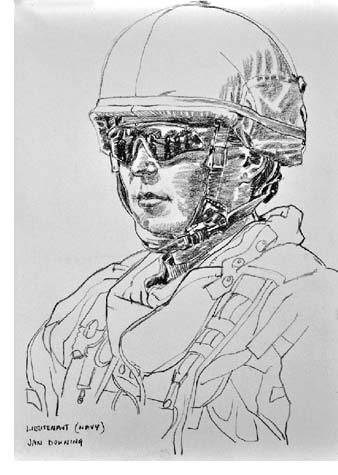
A Canadian, Lt. (Navy) Jan Downing (right) from Newfoundland, is the Aviation Medicine Advisor at the AAU. She is here to help build a sustainable program of Flight Surgeon qualification. A flight surgeon is a doctor specifically trained in the aspects of flight-induced medical problems. A flight surgeon makes sure that sick people are not flying or supporting the flight of aircraft.
“We [738th AES] along with the Afghan Surgeon General created and ran a course. We think it was a success, and we qualified six doctors as flight surgeons. And we’d like to qualify as many as we can so that in each big Air Wing they can do a flight physical or have that little bit more expertise. The continuing challenge is going to be Afghan involvement in the teaching part over the next few years. We have to leave someone to continue the teaching, ” she said.
This is Lt. (N) Downing’s second tour in Afghanistan. She previously spent two months in Kandahar Airfield at the Role 1 clinic in 2010. She volunteered to come back as an advisor on this deployment. “I got my taste down there, and I have always liked teaching. They (Canadian Forces) spotted my flight surgeon qualification when I volunteered and directed me here. . It is a cliché I know but, I am very lucky to be Canadian and live in the country that I do. I think serving for your country is an honor. It is very rewarding and very fulfilling,” she said.
The Afghan Air Force has been around in one form or another for almost as long as the Canadian Air Force. It was formed in the 1920s with help from the Brits and the Soviets. In the 1950s and 1960s it was the dominant Air Force in the region. But many of the pilots and technicians available today are the ones trained by the Soviets in the 1980s. A great deal of the important knowledge still rests with these AAF personnel. Read more.
On Twitter at @newsillustrator
Or see more of his work here at newsillustrator.com
Or contact Richard in the field at kandaharartist@gmail.com