


Apartheid and Everyday Life, at ICP
The Rise and Fall of Apartheid: Photography and the Bureaucracy of Everyday Life opened today at the International Center of Photography. Curated by Okwui Enwezor with Rory Bester, the exhibition examines the aesthetic power of the documentary form—from the photo essay to reportage, social documentary to photojournalism and art—in recording, analyzing, articulating, and confronting the legacy of apartheid and its effect on everyday life in South Africa.
The exhibition is stunning in every way. Presenting over 500 works by more than 70 South African photographers, artists and filmmakers, together with video, magazines, books, fliers and other ephemera, the exhibition not only documents the 60 year struggle against the racist and essentially criminal laws enforced by the Afrikaner National Party (ANP); most importantly, it portrays a diverse, multi-ethnic and multi-racial society striving to flourish under extremely difficult circumstances.
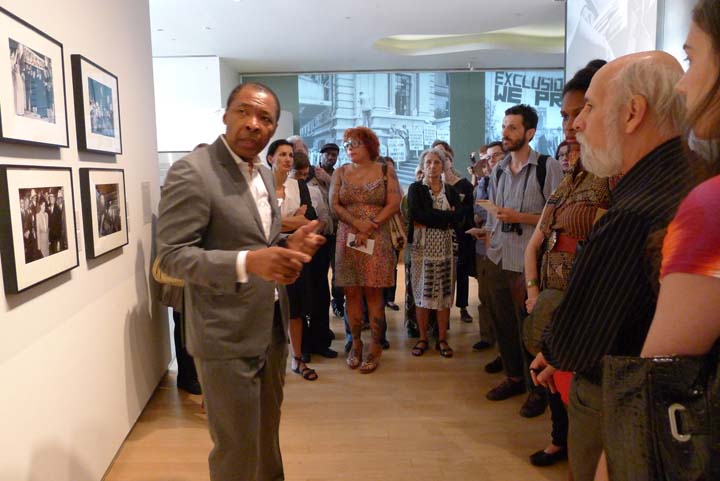
Curator Okwui Enwezor leads a walk-through of the exhibition.
At the curator’s presentation this morning, Mr. Enwezor (above) spoke of the “multiple theaters of history-making events" that generated a resistance movement in which the history of photography was re-written; how the anti-apartheid movement galvanized the world, creating a global force committed to bringing down the ANP; and how the United States, concurrently in the throes of the civil rights movement, formed unique ties with the people of South Africa.
In his introductory text for the exhibition, Mr. Enwezor wrote, “Essentially a neofascist culture, apartheid was put in place in 1948 after the surprise election victory of the Afrikaner National Party under the leadership of D. F. Malan. Between 1948 and 1955, the National Party introduced a series of draconian racial laws that incrementally narrowed into more restrictive policing mechanisms. Apartheid’s web of laws had a single crude goal: absolute segregation along racial and ethnic lines. Resistance to apartheid was in many ways a resistance to its laws. In the wake of these laws and the systems contrived for their enforcement—bureaucratization of everyday life—a well-organized, robust resistance movement, comprising South Africans of all racial and ethnic backgrounds and diverse political beliefs, mobilized in what became an epic struggle against the apartheid state and its policies.”
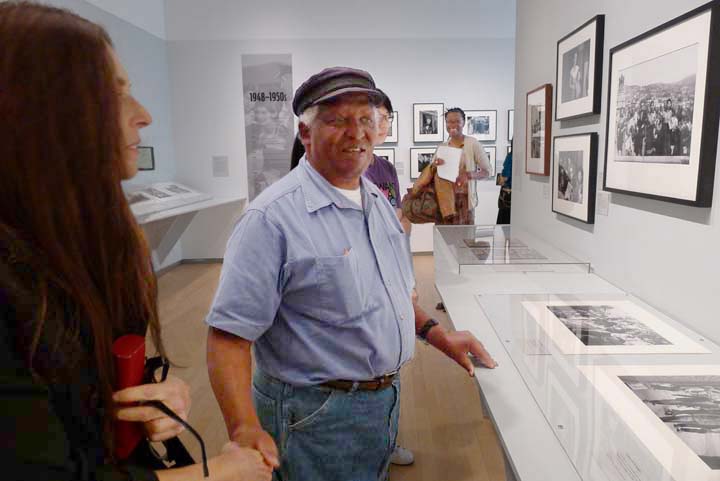 South African photographer Peter Magubane tells American photographer Margaret
Morton about being arrested while photographing protesters outside the prison where Winnie Mandela and 21 other political activists were being detained, in 1969.
South African photographer Peter Magubane tells American photographer Margaret
Morton about being arrested while photographing protesters outside the prison where Winnie Mandela and 21 other political activists were being detained, in 1969.
South African photographer Peter Magubane (above), who photographed for Drum magazine between 1955 and 1963, and later for Time, among other major news organizations, was arrested in 1969 for breaking the law prohibiting more than two people congregating in a public place. He told me that he took 17 hits of buckshot from the police who arrested him. He was jailed, in solitary confinement, for 586 days. On his release he was banned from working as a photographer for five years. I asked Mr Magubane if he still made photographs. He said that he did. “Reportage?” I asked? “No,” he replied, smiling. “Sunsets. Today I only photograph sunsets."
The Rise and Fall of Apartheid: Photography and the Bureaucracy of Everyday Life continues at the International Center of Photography through January 8, 2013. 1133 Avenue of the Americas, NY, NY. An exhibition catalogue will be published in October. Photos: Peggy Roalf.
ex_pm_4.28.16