


Robert Adams at Yale Art Gallery
The subject of most of my pictures is a troubling mixture: buildings and roads that are often, but not always, unworthy of us; people we are, though they participate in urban chaos, admirable and deserving of our thoughts and care; light that sometimes still works an alchemy.—Robert Adams
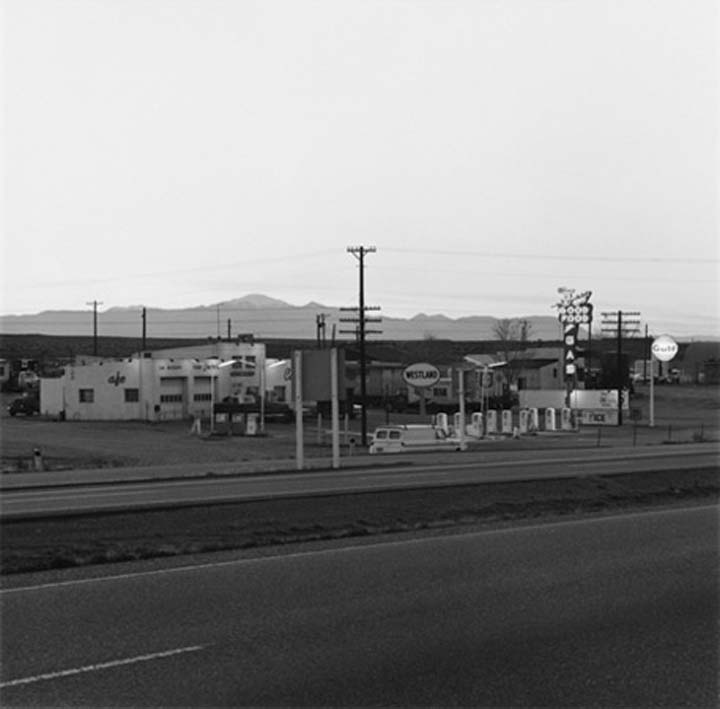
Since the late 1960s, Robert Adams has made the American West the subject of his work, both as a photographer and as a writer. Although his landscapes often record the uneasy meeting of nature and human culture, Adams does not shoot from a position of moral outrage. He sees prefab houses, gas stations, and industrial plants for what they are: characteristic aspects of the region where he lives. Striving for “an unarguably right relationship of shape, a visual stability in which all components are equally important,” Adams articulates his photographs with formal qualities that seem at odds with their content. Even in his pictures of roadside utility depots, a sense of proportion and balance gives dignity to the banal structures; nature still exerts a surprising grace, seen here in the rolling foothills of Colorado’s Front Range.
Above: Eden, Colorado, is named after a railroad official and not the Biblical paradise. To the east of the interstate highway that bisects it are railroad tracks, gas tanks, and a prefabricated metal shed. To the west, a roadhouse (closed), a military salvage lot, a car-wrecking yard, and the Westland truck stop. Extending beyond along the freeway are billboards advertising whiskey, real estate, and ice.—R.A., 1968
Robert Adams | The Place We Live, A Retrospective Selection of Photographs, opened last weekend at the Yale University Art Gallery, where it remains on view through October 28. The exhibition features over three hundred prints from the Gallery’s master sets of the photographer’s work, along with an array of his monographs. The exhibition traces Adams’s deep engagement with the geography of the American West, weaving together various aspects of over four decades of work into a cohesive, epic narrative of the American experience. 1111 Chapel Street, New Haven, CT. Information.