


Garry Winogrand at Denver Art Museum
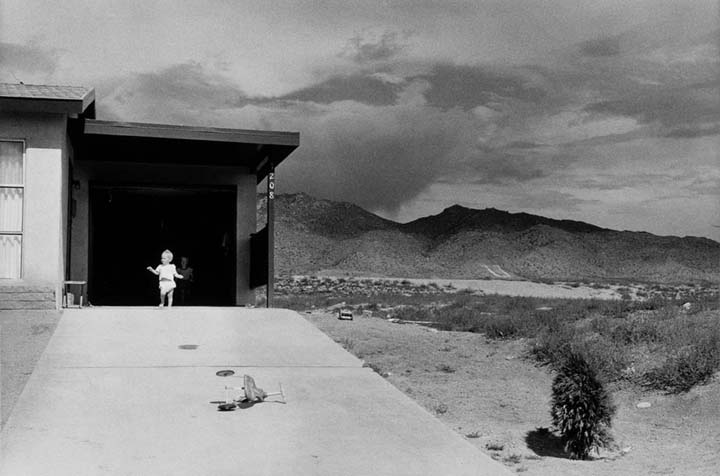
There is nothing as mysterious as a fact clearly described….I photograph to find out what the world looks like photographed.—Garry Winogrand
Often placed within the “social landscape school,” Garry Winogrand’s photographs turned ideas about documentary photography literally on edge when his work appeared in exhibitions during the 1960s. Self-taught, with Walker Evans’ book American Photographs as his sole reference to the history of the medium, Winogrand operated through a visceral response to situations he encountered. Visually expansive, yet confined to their author’s emotional range the subjects were often shot on an angle and studded with seemingly extraneous detail.
Winogrand adopted the motor drive, using his camera like a machine gun to capture slight shifts in movement and angle of view. To his critics, these photographs seemed too chaotic, to personal, too raw. The image above (which appears on the cover of Figments of the Real World), shot on a road trip in 1960, intimates signatures of Winogrand’s mature style. In a slightly off-kilter frame, a child engaged in no particular activity before a banal suburban house becomes an elemental figure of life. The classical triangular composition formed by the shrub and scooter, which point towards the child, who is silhouetted by the flat black darkness of the garage, is echoed by elements in the majestic landscape beyond.
Currently on view at the Denver Art Museum, through September 30, is a selection of 50 images from Winogrand’s 1975 collection, Women Are Beautiful. Information. A number of these images are available at Kopeikin Gallery, in Los Angeles.