


Panoramic Vistas: A Mania for Scope
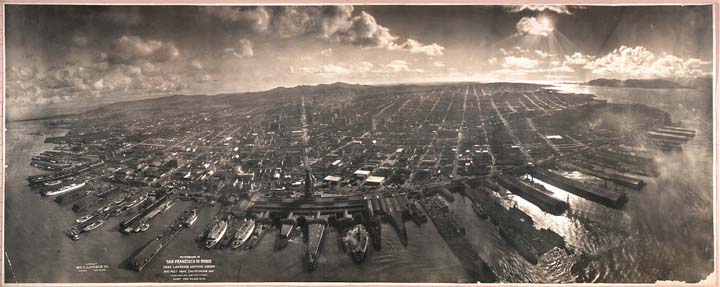
Photograph of San Francisco in ruins from Lawrence Captive Airship, 2000 feet above San Francisco Bay overlooking waterfront. Geo. R. Lawrence Co, 1906, courtesy Library of Congress.
Miniaturization in photography continues to trend along, with the Tilt Shift Generator for iPhone one of the most popular photo apps available. But it wasn’t always that way. In fact, soon after the daguerreotype was introduced in 1839, photographers began creating panoramic views of towns and villages by aligning a series of matched up single images. A trend was born! Photography offered a new way of picturing reality, or new and different versions of reality, and the panoramic vista became almost a mania in the rapidly industrializing world. During the Civil War, for example, the Union Army hired a photographer named George Bernard to create pieced panoramic views of fortifications that were used to strategize military actions.
Photographers and inventors began building special cameras with cranks and gears to smoothly pan across a view. With the introduction of flexible film in 1888, the process was revolutionized and a new industry was launched. The trade names alone—Megaskop, Cyclo-Pan, Cylindrographe—are Worlds Fair-worthy. The first mass-produced American panoramic camera, the Al-Vista, was introduced in 1898. The following year Eastman Kodak introduced the #4 Kodak Panorama camera that proved popular with amateur photographers.
A Chicago entrepreneur named George R. Lawrence (1869-1938) became an innovator in the field, using the slogan, “The Hitherto Impossible in Photography is Our Specialty.” His aerial shot from an "un-manned kite" after the devastating 1906 San Francisco earthquake (above) appeared in newspapers around the world and netted him more than $15,000.
The Cirkut, a rotating panoramic view camera that could advance the film and move the camera in synch, was patented in 1904, and was subsequently acquired by Eastman Kodak. Capable of producing a 360-degree image, the Cirkut became the most popular professional panoramic and was widely used through the 1940s. Five Cirkut film sizes were manufactured, although the No. 10 was the most popular and had the longest-running production. A step-by-step “how-to” on the Cirkut No. 8 is posted on The City of Vancouver Archives Blog, Authenticity.
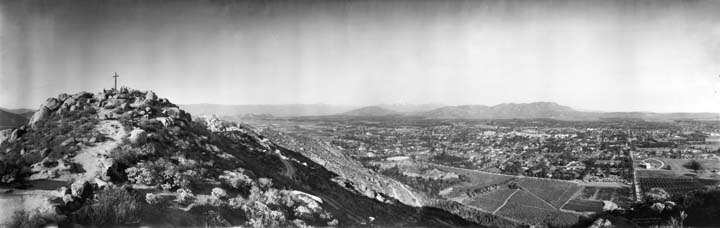
From 1905-1940, Haines photographed comprehensive views of major cities in the United States, which he marketed through the Haines Photo Company of Conneaut, Ohio and Glendale, California. He used a Kodak No. 10 Cirkut camera to make negatives that were ten inches wide and up to twelve feet in length.
i.e. California: Hines Cirkut Panoramas of the Inland Empire continues through September 22 at The California Museum of Photography. 3824 Main Street, Riverside, CA.