


New Photography 2007 at MoMA
The latest installment in New York's longest running fall show, "New Photography," recently opened at The Museum of Modern Art. Since 1985, with several years off during the museum's temporary relocation to Queens, the show has served as something of a barometer of what's new in photography. In its recent incarnations since returning in 2005, "the show has been not so much a survey," said curator Eve Respini, "but a view of work that is compelling and less familiar, by artists from different backgrounds, working in a variety of techniques."
This year's show zeroes in on three photographers: Tanyth Berkeley, of Brooklyn; Scott McFarland, of Vancouver, and Berni Searle, who works between Capetown, South Africa and New York. Each has honed a solid practice, creating fresh and idiosyncratic ways of viewing the world through photography. But the camera's ability to capitalize on the medium's intrinsic link with the passage of time forms a colorful thread running through the Robert and Joyce Menschel Gallery.

Scenes at the opening of "New Photography" at MoMA, September 25, 2007
Tanyth Berkeley's newest work, a series of nearly life-size standing figures, quietly play on art historical references as they press viewers to reconsider ideas about beauty. Her models are people she has met around town, mostly in the subway. Ariel, with a flowing mane of red hair, stands barefoot within the 70 by 29-inch oblong of Berkeley's print format. She faces the camera with attitude, which is slightly undermined by the hesitant placement of her right foot. Wearing an old-fashioned dress, Ariel might have stepped out of a Gustav Klimt painting.
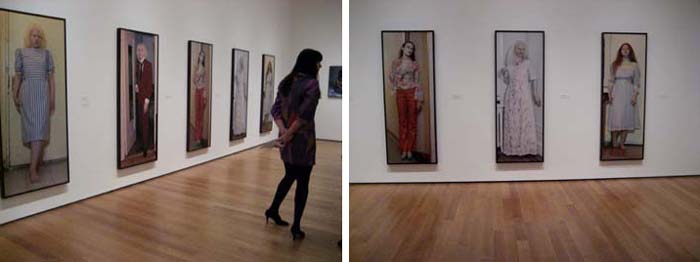
Photographs by Tanyth Berkeley in "New Photography" at MoMA
Equally compelling is Rick Wilder, a modern dandy who wouldn't seem out of place in a painting by John Singer Sargent. In the newest photograph from the series, Claire wears an elaborate gown of uncertain vintage. With her cascading white-blond hair and ice-pale skin, she represents uncommon beauty that is unrelated to class and privilege. The series of figures, squeezed as they are into the confining picture format, are like a beautiful butterfly collection destined for Berkeley's time capsule.
Scott McFarland's recent series from gardens and parks plays with the passage of time through digitally re-composed scenes he photographed over months, and sometimes, years. Orchard View with the Effects of the Seasons (Variation 1), a tour de force measuring 42 by 122 inches, presents farmland in Vancouver gone wild. The curious lack of shadows on the overgrown fields that lie beneath sparkling blue skies is the first clue that all is not what it seems. When you read the wall label and notice the date (2003-2006) it begins to register that the four seasons are represented here in a single image.
On the opposite wall, a cactus garden with a tall saquaros in the background is being invaded by a squadron of hassock-like specimens called echinocactus grusonii. Here, the impossibly even light has somehow managed to cast shadows that fall in all directions, belying the notion that photographs depict moments frozen in time.
Berni Searle, also known for her video and installation work concerning complex issues of identity, presents a series of compelling images based on family snapshots spanning three generations. In Still Passing By 1, she began by cutting silhouettes from red crepe paper based on groups of people in the pictures. When she submerged the cutouts in warm water, the silhouettes began to lose definition as the red pigment bled into the water. Recording this transformation on video, she then captured ten images which are presented here in two rows of prints. The title of this compelling series suggests that the self is always involved in the fluid process of emerging from the past to assume its own identity.
Across the room is Approach, a group of seven photographs of the artist climbing up and down mounds of crushed grapes from a mechanized harvest. Searle's journey alludes the traditional process of crushing grapes with the feet, as it was done in colonial times, and as her ancestors might have done. The formal quality of the images, with their beautiful colors, runs counter to the history of slave labor that served the Dutch and French wine-making culture of seventeenth century South Africa.
New Photography 2007 continues at The Museum of Modern Art. through January 1, 2008. Admission is free on Fridays from 4:00 to 8:00 pm, courtesy of Target. Please check the website for details.