


Art of the Atomic Age at the Guggenheim
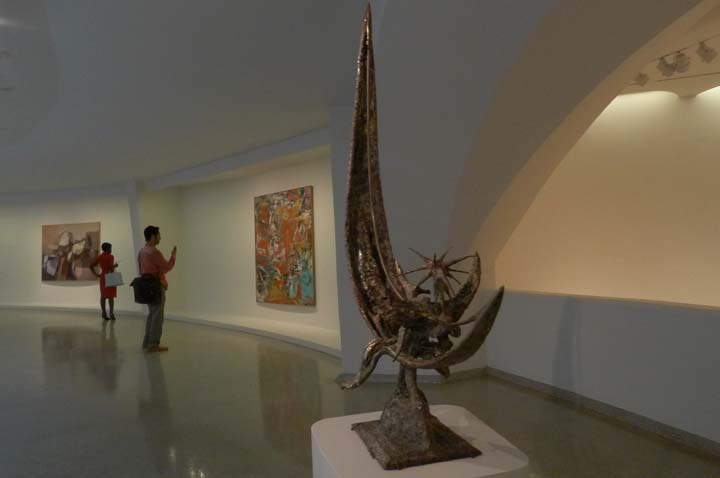
The exhibition Art of Another Kind: International Abstraction and the Guggenheim, 1949-1960 presents more than 100 paintings and sculptures acquired by the Solomon R. Guggenheim Museum’s second director, James Johnson Sweeney between 1952 and 1960. Mr. Sweeney took on the international avant-garde movements of the Atomic Age as his mandate for breathing new life into an institution that had grown somewhat stale under the leadership of its first director, Hilla Rebay. By the time the museum’s new building designed by Frank Lloyd Wright opened, in 1959, his work was nearly done. The collection Mr. Sweeney amassed reflected his view that “a museum should be a living organism…it should constantly prod the viewer to reach out from the familiar to the unfamiliar.”
I invited two painters to join me for the preview; on the spur of the moment I asked if they would like to contribute a commentary to DART about a work that seemed particularly outstanding. Daniel Horowitz, a painter and illustrator who recently showed work from his book 365 at The Invisible Dog Art Center, in Brooklyn, chose a painting by Willem de Kooning (1904-1997). Nick Lamia, a painter whose work is currently on view at Jason McCoy Gallery on 57th Street, chose a painting by Alberto Burri (1915-1995).
Daniel wrote, “In times of neatly packaged art produced for the consumer where effect is paramount to process, unrestrained self-expression is something that has become almost foreign to us. The paintings in Art of Another Kind hang as relics, forgotten by an all too clever world; though perhaps they are only familiar to an aspect of our psyche where thoughts are yet unformed. In the decade following 1949, artists plunged into truly unchartered territory—certainly not conceiving or tailoring their work for an audience. This allowed them to dive deep into individual self-expression. The risk implied in doing so was unimaginable, and the results were explosive.
“As art is often an abstraction of something concrete, 'Composition,' 1955, by Willem de Kooning, is abstraction in its most sublime form, for it is devoid of all representational elements. It is an outward scream, uncontrolled and intuitive that could only be channeled from deep within our ancestral animal brain, bypassing the frontal cortex, whose only purpose in this case would be to restrain.
“So in chaos there is order; the colors, textures, gestures are somewhat contained, but just barely, by the canvas’ edge. It is as if the painter has tapped into the aquifer of all creation, releasing a surge of force that borders the metaphysical. I once read of individuals who, upon sustaining injury to the frontal region of their brains, developed savant-like abilities. This demonstrates that our rational minds can be all together restrictive, and latent creativity must be unmasked by stripping away the layers of the mind. Turning oneself inside out, as did de Kooning, a true pioneer, required tremendous courage.”
Nick wrote, “I’ll admit it, I sometimes speed-walk through the final selections in big survey shows. And I bet I’m not the only one who does. But before you sprint past the tail end of Art of Another Kind at the very top of the Guggenheim’s spiral ramp, do yourself a favor; take a deep breath and slow down. Taking in this show is like sightseeing in the Sierra: there are nice things to see at every elevation but the especially fine eye candy rewards those who travel furthest upslope.
“Alberto Burri’s 'Wood and White,' 1956, one of the last pieces on view, stopped me completely. It’s an abstract image composed almost entirely from just a couple light and dark tones. Sometimes the dark acts as an object against a white ground, sometimes the reverse. Technically, this is called a 'figure-ground exchange' and it made me think I was looking at a Clyfford Still painting that had been separated from its sisters two or three levels below. When I got close and realized the image is constructed of several pieces of cut, burned through and cracked wood adhered over the surface of white painted canvas, I was surprised and impressed.
“To pull off a figure-ground exchange using different colors is one thing; to do it with different materials is remarkable. I looked at the wall text to learn the artist’s name and was surprised again as I scanned down and saw the word 'veneer' describing the medium. The piece seems so solid I thought the wood sections were planks. I had to go back to scrutinize the thickness of the edges before I believed the wood could possibly be wafer-thin slices, which it is.
“It was terrific to have my eyes opened this way at the end of the exhibition by an artist I had been unfamiliar with—it reminded me that whether it’s an unusual dessert that puts an exclamation point at the end of a meal, or a walk-off home run to end a ball game, sometimes it’s the final flourish that makes an experience truly remarkable. Just be sure you’re not moving too fast to appreciate it.”
The title of the show, Art of Another Kind, comes from the French art critic Michel Tapié who defined the new avant-garde by its otherness and its rejection of all traditions, including Modernism. Mr. Sweeney put an American spin on this idea, championing the art of “tastebreakers": artists such as de Kooning, Jackson Pollack, and Jean Dubuffet, who would soon become the “tastemakers.” Sweeney consistently took his own advice, collecting work by many artists little known at the time whose paintings are still somewhat unfamiliar today, which brings hidden surprises at each level along the spiral ramp.
The exhibition catalogue includes essays by the curators Tracey Bashkoff and Megan M. Fontanella, along with an essay on abstract sculpture by Joan Marter. Together they bring out the pioneering spirit of these artists who embraced a new artistic freedom, creating gestural styles using non-traditional materials and counter-cultural references. Beautifully designed and printed, with a handsomely blind-embossed linen cover, the book includes a timeline and studio shots of artists at work.
The museum has organized a series of innovative public programs, including a creative writing workshop tomorrow at 1:30 pm: Tastebreakers | with artist Karen Finley; approximately 90 minutes, including reception. Tickets $10/$6.
Art of Another Kind: International Abstraction and the Guggenheim, 1949-1960 continues at the Solomon R. Guggenheim Museum through September 12, 2012. 1071 Fifth Avenue, at 89th Street, NY, NY. Photo: Peggy Roalf.
06192012