


Christenberry at Jackson Fine Art
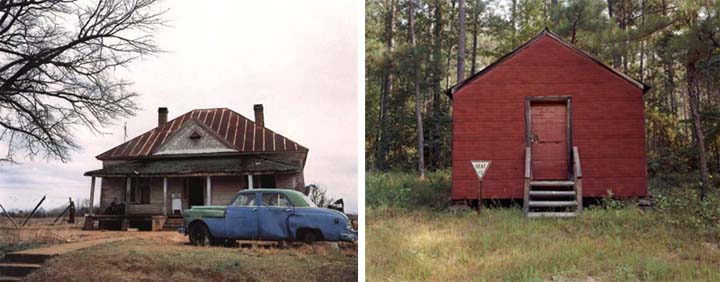
While the post-war American Dream was being broadcast as Kodak moments through mammoth Coloramas in Grand Central Terminal, starting in the 1950s, the young William Christenberry was exploring the world he knew best, using a little Brownie Box camera. As an artist making paintings and sculptures, he often took snapshots to record the subjects of his concern: tenant farmer shacks; rural churches; graves; roadside stands with fading hand-lettered signs that dotted the landscape of his childhood home in Hale County, Alabama.
Christenberry came to New York in 1961 and met Walker Evans, who late in his career was the photo editor at Fortune magazine. According to the record, Evans took a shine to the young man and encouraged him to continue photographing the territory that he himself had previously put on the map in Let Us Know Praise Famous Men (1939), which he created in collaboration with author William Agee for the Farm Security Administration during the Great Depression.
Christenberry, who stayed only a year in New York, and in 1968 moved to Washington, D.C., returned to the rural South each year, often photographing the same places from the same point of view. He catalogued a variety of building types as they succumbed to decay brought about by the humid conditions of the South and sometimes to destruction. Some were devoured by the fast-growing kudzu weed that can turn anything into an oversized Chia Pet; some collapsed under their own weight; a few endured the ravages of time to become stately icons of a new type that has influenced many photographers of subsequent generations.
His best-known works are his small color photographs (some no more than three inches square) of a single building, often an abandoned or boarded-up house or church, in a woodland setting. Evans once famously disdained color as “vulgar” in contrast to the austerity of black and white. But Christenberry isn’t trying to sell us anything. His saturated palette of brick reds, kudzu greens and dirt browns, as well as the miniature scale of many of these prints, harks back to the vernacular tradition of picture postcards rather than to the sublime or the grandiose.
His observations on a lifetime of visits to his boyhood turf was collected in a small book, Working from Memory (Steidl 2008) which includes 50 color plates. The work is currently on view at Jackson Fine Art through June 8th. 3115 East Shadowlawn Avenue, Atlanta, GA. Above. Left: House and Car, Near Akron, Alabama, 1981. Right: Red Building in Forest, Hale County, Alabama, 1974-2004. Copyright William Christenberry, courtesy Jackson Fine Art.
05302012