


From the Floor at AIPAD: Thursday
I won’t lie—I love The AIPAD Photography Show (AIPAD). Some of the most interesting photographs ever made, from the 1850s to the present, and this year with a fairly large selection of contemporary and experimental work, are on view at The Park Avenue Armory.
Most dealers present a selection of images by a variety of photographers that they feel are likely to attract buyers—after all, this is a trade fair, although well-disguised as a museum-quality group show. The one exception this year is David Zwirner Gallery, which hosts a mini-retrospective of Philip-Lorca diCorcia’s work, including two massive landscape images from 2008-09, a grid of undated Polaroids, and a portrait from the “Hustlers” series, dated 1990-92.
What makes this show fascinating and challenging is the fact that it is otherwise non-thematic. For collectors, this is not such a problem because they generally have a good idea where to start looking. For those who head to AIPAD because they love photography, it can seem like a tsunami for the eye and the mind.
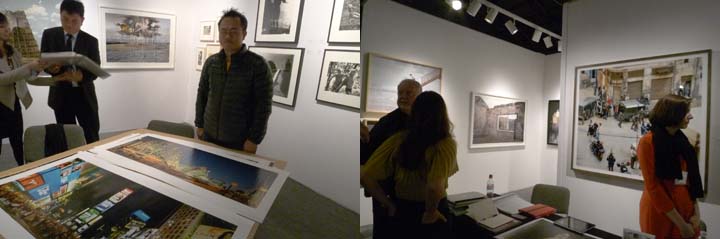
But many photographers are on hand to present their work; I caught up with Jeff Chien-Hsing Liao at Julie Saul Gallery (above left) after seeing one of his stitched panoramas from his ongoing “Survey” series: a view of the Flatiron Building from high above street level, with a crowd of hundreds in the foreground; the first row is in sharp focus while the rest of the people and the building seems to dissolve into the glowing dusk atmosphere. Jeff is currently working on a major series on Staten Island, which will be seen at the Museum of the City of New York this fall. At the same time he’s also working on a long-term series on Coney Island.
At Andrea Meislin Gallery (above right) you’ll find a group of photographs by Israeli artists, including Michal Chelbin’s series on prisoners. Lili Almog was there yesterday to present her new project, “Between Presence and Absence,” which took her to the kibbutz near Haifa that was destroyed in the Mt. Carmel forest fire in 2010. She photographed the remains of a culture that grew out of the ashes of the Holocaust; her photographs of the charred imprint of the survivors’ belongings after the Mt. Carmel fire do not fail to stir analogies.
This year I’ve noticed what begins to look like a backlash against color images printed as large as technology allows. For example, in the winter issue of Photograph magazine, I counted over 120 exhibitions from coast to coast that featured vintage and contemporary black-and-white photography. Here are a few things I saw at AIPAD along those lines:
There are still plenty of extremely large color images, but there are also quite a few wall-size installations of smaller color images installed on a grid. At Catherine Edelman, John Cyr, has a series of almost abstract rectangular objects against black backgrounds, in black frames (below left). Installed three across and three down on a gray wall, they make a powerful, graphic statement. I asked the photographer what he was up to; he told me that shooting the developer trays of notable photographers was his MFA thesis project at the School of Visual Arts. He first contacted Emmet Gowin, who agreed. After that, he said, he was almost never turned down. The installation is fascinating in the way it also reveals advancing technology in the manufacturing of ordinary objects.
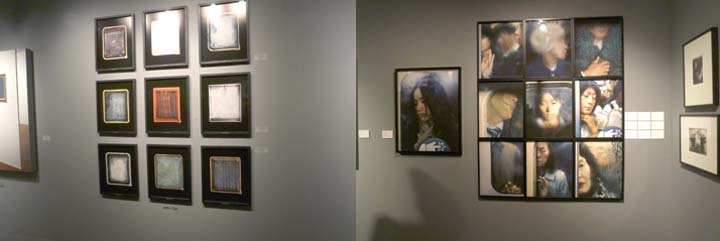
At Robert Koch Gallery is a grid installation of roughly 16-by-20-inch color prints from Michael Wolf’s series of sleeping commuters, “Tokyo Compression” (above right). Photographed during the morning rush, the faces of his subjects almost melt against the glass windows of their crowded trains, conveying the degree to which we can become vulnerable.
So then I went on a hunt for grid installations and was struck by several groupings of black-and-white images throughout the Drill Hall. At PDNB Gallery is a series by Vitaly Smirnov of old wooden garden sheds used by Muscovites at their weekend dachas. Shot in 2008 and printed not much larger than postcards, with a sepia wash, this group of images suggests timeless connections and family histories. At Sasha Wolf Gallery are a group of Peter Kayafas’s collapsing sheds from the “Totems” series; At Robert Mann Gallery, a group of trees by Michael Kenna; at Eric Franck, the inevitable selection of classic images by Henri Cartier-Bresson; at Verve, a beautiful set of portraits of amazingly tufted chickens by Beth Moon and an image of flowers titled “Engagement Peonies, printed in platinum palladium, by Brigitte Carnochan—both from 2012.
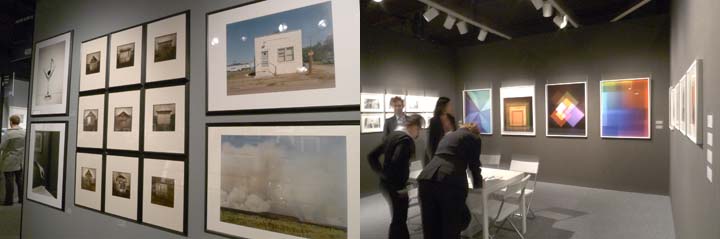
Back to color for today’s windup. At Higher Pictures, Kim Bouros has installed four prints of abstractions in brilliant hues by Jessica Eaton (above right) that can be seen from one end of the Drill Hall to the other. I saw the gallery presentation last fall and was intrigued by Eaton’s artistic process, which is one of sculpture as well as photography; she builds paper models out of white board, then creates color effects using gels and multiple exposures, shooting in four-by-five. While the crafting of the models is superb, wonderful traces of the artist’s touch remain in the final images.
Last are the extraordinary images of wild creatures in sumptuous palaces in “India Song” by Karen Knoor. In these gilded surroundings cranes, zebus, langurs, tigers and elephants mutate from princely pets to avatars of past historic characters, blurring boundaries between reality and illusion. These can be seen at Eric Franck as well as at Danziger Gallery and bring an air of fantasy to the hall.
The AIPAD Photography Show runs through Sunday, April 1 at The Park Avenue Armory. 643 Park Avenue at 67th Street, NY, NY. Seventy-five of the world’s leading fine art photography galleries will present a wide range of museum-quality work, including contemporary, modern, and 19th-century photographs, as well as photo-based art, video, and new media. Information.
This year, AIPAD’s panel discussions will be held on Saturday, March 31, at Hunter College, the Hunter West Building, located at Lexington Avenue, corner of East 68th Street, room HW615. Tickets, $10 for each panel, are available only at The Park Avenue Armory during show hours.
03302012