


The 2012 Whitney Biennial
The first day of March in any even-numbered year brings a lion’s share of contemporary art to New York City in the form of the Whitney Biennial. This year the museum, under the leadership of its director, Adam Weinberg (below, left), highlights its continuing emphasis on performance in art, as well as its sensitivity to a recovering economy, in the 76th edition of this survey exhibition.
v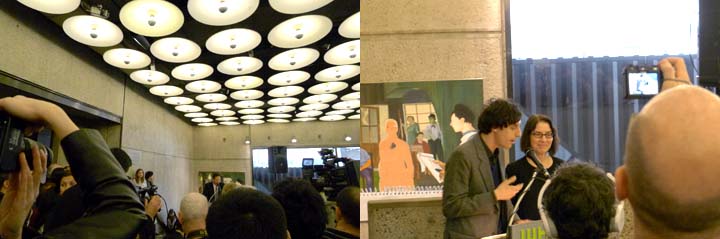
The Biennial, previously regarded as a lollapalooza of extravagance on many fronts, is scaled down this year, with works by 51 artists (down from over twice that number in 2006) on view. The overall effect is one of spaciousness and spareness that makes one of the Whitney’s missions—that of informing without being professorial—unusually evident.
For example, the idea that the Postmodern and continuing practice of appropriation is grounded in its performative aspects becomes surprisingly clear in Lutz Bacher’s The Celestial Handbook. This piece consists of 85 pages from an astronomy manual the artist exfoliated and framed, and is installed in various locations throughout the museum.
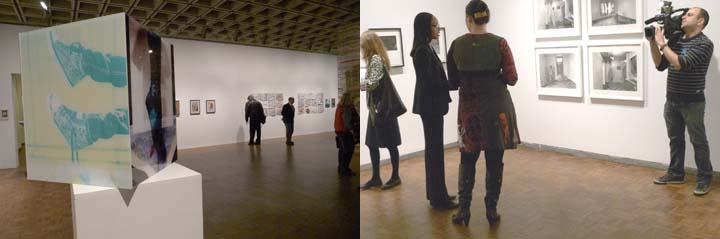
At the opposite extreme is an installation by Los Angeles artist Dawn Kasper who moved the contents of her messy nomadic workspace into the Whitney. Throughout the run of the Biennial, she will be creating art, taking naps, and interacting with visitors. She says, “My time in process is an important part of my performance work, as revealing that process publicly.” Daring for a museum exhibition, for sure, but keep your kids away from this one.
One of the highlights of the film and video installations is a piece by Werner Herzog that brings together art by the 17th-century Dutch artist Hercules Segers with music by contemporary Dutch composer Ernst Reijseger. The 18-minute film wraps around three walls of an enclosed space; the experience is immersive and elevating in the way that a spiritual pilgrimage might be.
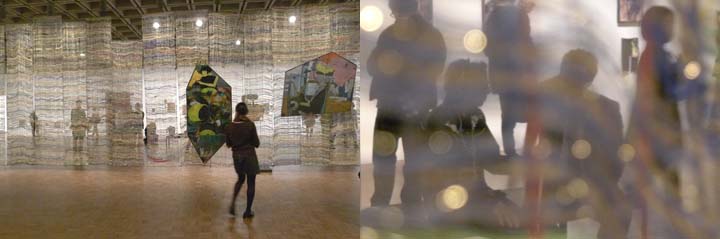
Abstraction, both in painting and sculpture, has found a home on the third floor with works by two San Francisco artists: Andrew Masullo with his small vibrantly colored canvases, and Vincent Fecteau with a group of sculptures made from cement, gypsum and clay.
Much of the still art on view expresses time-based ideas of process and product. And several notable American artists who first made their mark long ago are included in this year’s Biennale. In Ariadne’s Thread (below left), Elaine Reichek created a series of embroidered and tapestry artworks that address the Greek myth of Ariadne, who fell in love with the warrior Theseus; she aided him in his struggle to subdue the Minotaur by laying threads throughout the Labyrinth of Crete that enabled Theseus to escape.
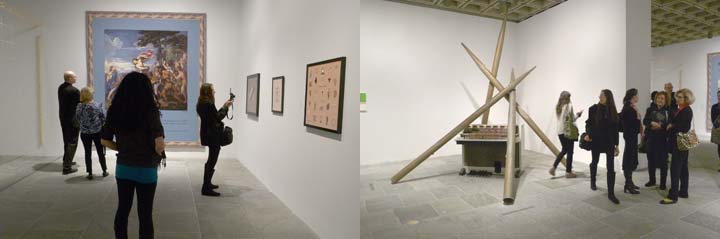
Forrest Bess (1911-1977), a unique loner, seasonal bait fisherman, and painter from Texas, who somehow came to the attention of the scholar Meyer Shapiro, who introduced him to gallerist Betty Parsons, who represented him from 1949 to 1962, is represented in a mini-retrospective that showcases his extraordinary talent and idiosyncratic point of view. He created small, visionary paintings that he believed had the potential to relieve the suffering of mankind.
Occupying all of the Whitney’s galleries except for the 5th floor, this is a show to experience on many levels and through several visits. For now, stay tuned for further highlights in DART.
Co-curated by Elizabeth Sussman of the Whitney and independent curator Jay Sanders (row 1, right), The Whitney Biennial 2012 opens March 1 and continues through May 27th. The Whitney Museum of American Art, 945 Madison Avenue at 75th Street, NY, NY. Information about performances and public programs. Photos from yesterday's media preview: Peggy Roalf.
02282012