


Paris Photo 2011 at Grand Palais
The fifteenth installment of Paris Photo takes over the magnificent belle époque Grand Palais, bringing together 118 international galleries and shining a spotlight on sub-Saharan African photography, from November 10th to 13th. See a slideshow of selected images on exhibit here.
This year, Paris Photo celebrates the photo book, with a new space dedicated to international publishers and specialist booksellers, and the launch of the first Paris Photo Book Prize. An international jury including Markus Schaden, Germany; Harper Levine, United States; Satoshi Machiguchi and Hisako Motoo, Japan; and Antoine de Beaupré, France honored a photo book that has had significant impact over the past 15 years. The award went to Paul Graham for A Shimmer of Possibility (Steidl, 2007) and was made possible in collaboration with Aperture Foundation and with the support of Leica.
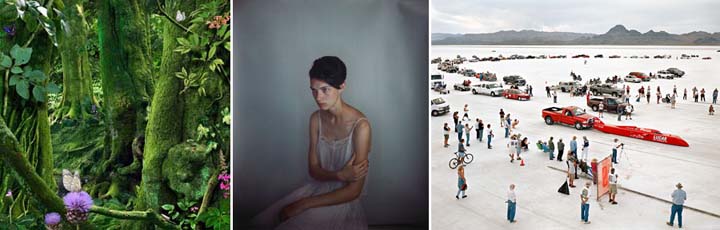
Left to right: Ruud van Empel, Theatre 3, 2010, © Flatland Gallery, Utrecht. Right: Richard Learoyd, Harmony, 2011, © Fraenkel Gallery, San Francisco. Edward Burtynsky, Bonneville #1, Start Line, Landspeed Trials, Bonneville Salt Flats, Utah 2/10, 2008 © Edward BURTYNSKY, courtesy Howard Greenberg Gallery.
In the days leading up to the opening, La Lettre de la Photographie asked a number of gallerists their opinion about the financial side of the photography market. Following is a selection of their responses.
Michael Hoppen Gallery, London
The market for photography is in its infancy. Collecting only
started in earnest in the 1990’s and continues to gather pace. It covers traditional photography and artists working with photography and the collector circle gets wider and wider. It shows no
boundaries and a photographer from Eastern Europe is on a par with a photographer from China. We see huge potential growth on all fronts and are very excited by all the new clients entering the market
to collect photographs. —Michael Hoppen
Flatland Gallery, Utrecht, The Netherlands
It is still booming. It
is very very strong, there is not only a growing interest of the collectors side, but also on the buyers point of view. —Martin Rogge
Fraenkel Gallery, San Francisco, CA
The position of photography within the broader context of the art world has never been stronger. There has been
a proliferation of the number of artists working with photography and for whom the photographic object is the final form. The walls that separated photography from the rest of the fine arts during
much of the 20th century have fallen. The question of whether or not photography is an art is now a laughable one. Accompanying this position is a concurrent growth in the market for photographs. The
history of the medium, far beyond the pale of the established canon of decades passed, is being fleshed out with unbridled enthusiasm. Important historical photographs—and, it should be noted,
photographic books—as well as works by rising stars of the contemporary scene are commanding prices unheard of in previous years. We expect to see this trend continue. Fraenkel Gallery has, for
the past 32 years, played an important role at the forefront of the growth of the market for the best works in the medium. We’re excited about continuing that legacy deep into the
future.
Flowers Gallery, London
I would say in light of these times of austerity—photography print sales remain buoyant. If
anything we have seen an increase of interest and acquisitions. —Chris Littlewood, Director of Photography
Gitterman Gallery, New York City
The connoisseur side of the market remains strong. Surprisingly, we had a much more active summer
than usual and this fall has been very good thus far.
Grafika la Estampa, Mexico City
The Grafika
la Estampa gallery is proud to participate for the first time in Paris-Photo. We have been following the market for photography for more than ten years, back when it hardly existed in Mexico, apart
from a few American and European collectors who had the foresight to see the place that photography would make for itself in the international art market. Being the sole gallery from a Latin-American
country at Paris-Photo provides us with an opportunity to break into that market. We believe that the public is eager for new work, and the proof is the growing interest in Latin-American photography.
Horacio Fernandez’s El Fotolibro Latinoaméricano is only the most direct evidence of the creation of this new market. Financially speaking, we can say that the increased value of
photography, thanks to an increased interest by collectors and institutions alike, has made it a safe choice for whomever is willing to invest. —Tania Sanabria, Director
Howard Greenberg Gallery, New York City
Photography continues to be a solid alternative investment even in today’s turbulent economic
market. Proven masters from classic twentieth century photography are an excellent choice. Those from between the wars continue to receive the highest records in prices and consistently have been
shown to hold their value even in short-term ownership. Also, there are still worthy periods of photography not yet fully explored. For example, there are many undervalued street photographers from
the American mid-century that we feel confident will increase in value over the coming years including Leon Levinstein, Bruce Davidson, William Klein, Louis Faurer and Saul Leiter. Our recommendation
for collectors is to find galleries to work closely with that have the ability and expertise to fully inform their clients on all aspects of collecting including market factors. Howard Greenberg
Gallery has worked with museums, private collectors and investors for over 30 years. This season the gallery is expanding its 57th Street, New York location. We feel extremely positive for the future
of collecting photography as an investment.
Andrea Meislin, New York City
Perhaps, during unstable economic times, more and more
people are looking for alternative ways to invest their money. Artwork is a perfect alternative as it is a tangible asset that can be enjoyed for generations. And because of the nature in which
photography is sold—by edition—it makes it easier to start collecting within each individual’s comfortable price range. —Adrienne Meraz
Forma Galleria, Milan
Despite the worldwide economic crises, collectors through diverse channels—fairs,
auctions, private sales—clearly demonstrate a renewed confidence in the photography art market, showing firm demand for this medium. Traditionally, the photography market is undervalued compared
to other segments of the art market. One can purchase quality work by well-established artists for a relatively low price. In addition, this market segment is less volatile than contemporary art. It
has its blue chip and well-established artists with a growing market and rising interest.The photography art market most definitely holds unrevealed potential.
Brancolini Grimaldi, Florence/London
Although the market for photography in London is still young compared to New York or Paris, it has grown
exponentially over the last few years. While New York is more focused on contemporary and Paris on vintage photography, London stands at the forefront of both fields. There have been more and more
important exhibitions in the major London public institutions, among others the Victoria & Albert Museum, The Photographer’s Gallery and the Barbican Art Gallery which all exhibit a wide
range of photography. The main auction houses in London have held photographic sales for many years. Collectors are increasingly serious in building up their collections. They compete with
institutions by seeking out special pieces without space constraints, the aim being to build a collection and not just hanging work in their homes. We believe in the future of photography and the
contemporary art market in London and feel it’s an exciting time for us to be here.
11112011