


Starting an Art Collection: Five Questions for Tom Delavan
In conjunction with the Affordable Art Fair, opening Thursday at the Metropolitan Pavilion, the School of Visual Arts is hosting a panel on starting a contemporary art collection. DART caught up Tom Delavan, Editor-at-Large of Domino magazine and one of the panelists, to get his advice first-hand.
Peggy Roalf: Let's say a new collector comes into some money and has
$10,000 to start an art collection. Where should he begin?
Tom Delavan: Figuring out what you like sounds kind of obvious but start looking around. New York City, with its huge
concentration of galleries, auction houses, art fairs, and museums makes this easy. If you live somewhere that doesn't have a lively art scene, you can start looking through art magazines and shelter
magazines to raise your awareness about what you like.
If you live in New York or a city that has lots of galleries, start going to the shows twice a month. Go to the openings too, and when you find an artist, or a style in art that you like, try to develop a relationship with some dealers who show that kind of work.
PR: When my new collector sees something he
really likes but it's beyond reach, what should he do?
TD: Let's say he fell in love with an Ellsworth Kelly painting he can't afford. But still, he's one step ahead because he
knows what he wants. He could look for an Ellsworth Kelly drawing, and if that proves to be too high-priced, he should start looking at prints. And within the range of prints, or multiples, he can try
to find a larger edition, in which case the price would be somewhat lower than an edition of just 10 impressions. You can still find a good-sized Ellsworth Kelly print for around $5,000.
Your collector could also analyze what he likes about the Ellsworth Kelly painting: hard-edged geometric abstractions in bold colors - and start looking for work in a similar style by another artist.
The thing to remember is that when it comes to buying art, there's no rush. It's not like furnishing a home, where you really can't live without a bed, a table, or a sofa. With art, you can take your time to find what you like, what you want to live with and grow old with.
PR: When you read about an Andy Warhol going for more than $17 million, how do you reckon with
the idea of art as an investment?
TD: Buying art, in a way, is analogous to investing in stocks and bonds: there are blue chip artists and there are emerging artists. While
buying work by emerging artists is definitely more affordable, it's also riskier. That's why it's so important that you really love the piece. Eventually, it may end up not being worth anything. If it
does go up in value, then you're lucky.
 But again, it's important to do your homework. Say you found two pieces you really like and can't decide which one to get. Read the artists' bios. Maybe one of them has
already had a couple of exhibitions, maybe they even got reviewed. If you like both pieces, go with the artist who's already started building a reputation - it might enhance the value of the piece
some day.
But again, it's important to do your homework. Say you found two pieces you really like and can't decide which one to get. Read the artists' bios. Maybe one of them has
already had a couple of exhibitions, maybe they even got reviewed. If you like both pieces, go with the artist who's already started building a reputation - it might enhance the value of the piece
some day.
PR: How do you distinguish between an art collection and an accumulation of pieces?
TD: When you see important collections that come up for
sale at Christie's or Sotheby's, you notice that they always have a theme. The collection says that its owner liked a certain kind of art and made great choices. When your new collector goes out
looking, maybe he finds that he really likes portraits of animals, so maybe he starts out by getting one of Jeff Koons' ceramic puppy multiples.
Or let's say my collection would be nothing but white art. I'd look for paintings by Robert Ryman, Cy Twombly, Agnes Martin. And I'd have a white marble sculpture, by Jean Arp....That would be a dream collection! The point is that your collection should reflect your interests and your passions.
PR: What was the first significant piece you bought for your own collection?
TD: I saw something I
really liked by an artist named Joseph Grigely at the Whitney Biennale some years back. For that exhibition, he did a piece that consisted of post-its of different conversations he had had with
people. He's deaf, by the way. I went to his gallery, where they had his sculptures of dogs based on a series of paintings by the Italian Renaissance painter, Canaletto. Grigely said he was attracted
to these images because to him they implied a lot of noise and people reacting to sounds; they represented a world he felt excluded from. I couldn't afford a piece at the time, but I couldn't get them
out of my mind. Six months later, when I was about to buy something else, I thought about the Grigelys again, and said, "If I don't buy this painting, I'm half way to buying one of those dogs." So I
saved my money and ended up with something I really love.
The Affordable Art Fair New York City, June 14 - 17, 2007
SVA's Affordable Art Panel. First Steps: Beginning and Developing Your Collection. Saturday, June
16, 2 pm. Free with AAF admission.
Metropolitan Pavilion, 125 West 18th Street, New York, NY
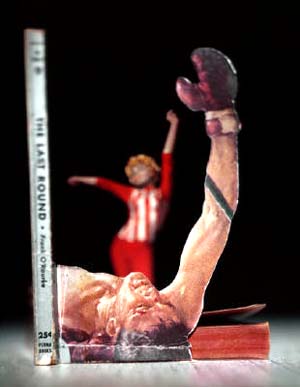
Picture credit: Thomas Allen, Knockout, 2006. Courtesy of Foley Gallery and on view at the Affordable Art Fair.
061307 delavan