


Photo-Poetics at the Guggenheim
Photo-Poetics: An Anthology, on view at the Guggenheim, presents works by 10 contemporary photographers who use the camera as a weapon to make viewers think. Installed in the Tower's 3 main floors, the show offers a close reading of the works in intimately staged solo shows. This might be the most agressively anti-art-fair exhibition to grace a New York winter in recent years.
To borrow from the introductory wall text, "The works in this exhibition, rich with detail reward close and prolonged regard; they ask for a mode of looking, in real time, that is closer to reading than the cursory scanning fostered by the clicking and swiping functionalities of smartphones and social media." At risk of being branded a Luddite for this statement, curator Jennifer Blessing, assisted by Susan Thompson, has instead organized a captivating show that mines these artists' inner perspectives on the meaning of art.
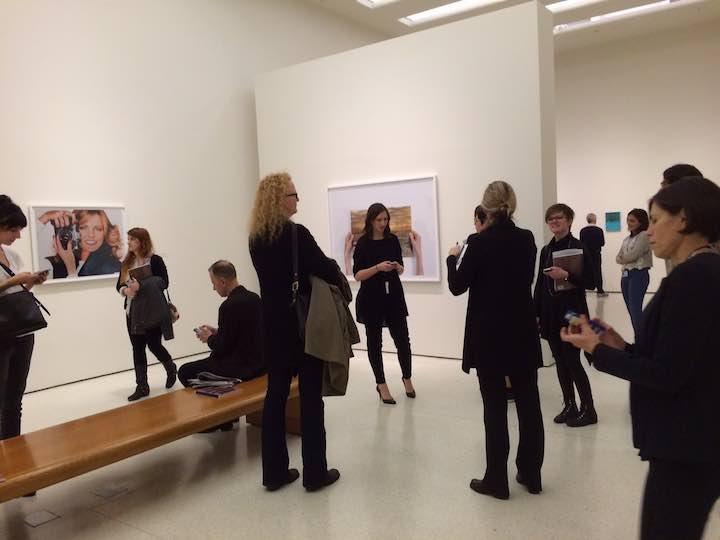
Predominately studio-made still-lifes, many incorporating discarded ephemera, advertising images and celebrity shots, the images embrace the qualities of photography that set it apart from the plastic arts while using traditional art motifs to promote the idea of art-as-object. Photo above: Peggy Roalf.
Anne Collier, known for her series "Woman With a Camera," in which she takes media images of celebrities from the '60s and '70s, reveals the underlying sexism common in advertising then—and now. In Woman With a Camera (Cheryl Tiegs/Olympus 1), 2008, the girl-next-door supermodel aims a professional-quality camera at the viewer, handling it in a way that would surely negate a professional result. But the model's beaming good looks demand devotion to the object of desire she holds. The artwork as an object of desire is much less stable. It would hardly get a glance amid the side-show atmosphere of a major art fair, but in this intimate setting, it prevails (at left in photo above).
Riffs on Real Time, 2002-2009, by Leslie Hewitt, is represented by an entire set of ten images. Taking discarded artifacts from mass culture such as newspapers, magazines, books, manila envelopes, amateur snapshots, and other ephemera she then composes the objects into stacked arrangements and photographs each composition against the backdrop of residential hardwood floors or carpets. Often culled from vintage sources and discards, the aged images refer to the passage of time, with a nostalgic overtone. By playing with the characteristics inherent in photography, she transforms the meaning of the source materials, often gathered from African American communities, particularly 1960s civil rights memorabilia. With these found signifiers Hewitt "writes" a metaphorical commentary on how memory, history, and common materials can be manipulated, transformed, restaged, and in turn can shape the lens through which American culture and even art making is viewed.
 Elad Lassry uses photography,
primarily portraiture, to create formal objects with highly finished surfaces that advance the notion that we shouldn't believe everything we see. Furthermore, his preferred size is close to that of a
magazine, generally 11-by-14 inches, which he says is the antithesis of the type of gallery photography espoused by Dusseldorf school artists like Andreas Gursky and Thomas Ruff. While
denying the artistic concerns of the gallery system, Lassry adopts some of the methods of Gursky and Ruff, including a slick, ultra-shiny surface, and adding frames painted to
match the background of the image. By creating accessible images that look factory-made, using borrowed images, like a studio portrait of Anthony Perkins, or a studio portrait of a prized Bengal
cat, Lassry plays with the viewer's knowledge and expectations. Left: ©Elad Lassry, Bengal, 2011. Chromogenic print in painted frame.
Elad Lassry uses photography,
primarily portraiture, to create formal objects with highly finished surfaces that advance the notion that we shouldn't believe everything we see. Furthermore, his preferred size is close to that of a
magazine, generally 11-by-14 inches, which he says is the antithesis of the type of gallery photography espoused by Dusseldorf school artists like Andreas Gursky and Thomas Ruff. While
denying the artistic concerns of the gallery system, Lassry adopts some of the methods of Gursky and Ruff, including a slick, ultra-shiny surface, and adding frames painted to
match the background of the image. By creating accessible images that look factory-made, using borrowed images, like a studio portrait of Anthony Perkins, or a studio portrait of a prized Bengal
cat, Lassry plays with the viewer's knowledge and expectations. Left: ©Elad Lassry, Bengal, 2011. Chromogenic print in painted frame.
In line with the idea of taking time for a close reading of these "collected" works, the exhibition includes a reading nook offering copies of the beautifully designed and produced catalogue.
A schedule of public programs will introduce eight of the photographers in round-table disussions. Tickets
Lisa Oppenheim, Sara VanDerBeek
Wednesday, January 27, 6:30 pm
Elad Lassry, Erin Shirreff, Kathrin Sonntag
Wednesday, February 24, 6:30 pm
Claudia Angelmaier, Erica Baum, Moyra Davey
Wednesday, March 9, 6:30 pm
Photo-Poetics: An Anthology continues through March 23. The Solomon R. Guggenheim Museum, 1071 Fifth Avenue, at 88th Street, Fifth Avenue, NY, NY. Info
Ed. Note: In yesterday's
DART Board, the title of David Maisel's exhibition was misspelled, here corrected:
David Maisel | The Fall, 5:30-7:30 pm. Haines Gallery, 49 Geary Street, San Francisco, CA.