


Nick Cobbing: Arctic Pagophile
In the midst of the Copenhagen Climate Change conference, I had email from Nick Cobbing, a London-based photographer who has made the Arctic Circle his beat. I asked him what there was about the region that suited his nature, and he said, "From my first visit there, in 2000, I was transfixed by the Arctic. Apparently there is a word for someone or something that thrives in ice: pagophile. I'm not sure that I thrive there, being dependent on a ship and crew, but I am certainly very happy there."
Transfixed myself by the allure of Nick's new photographs, I fired some questions his way yesterday. Here's the conversation:
Peggy Roalf: When did your recent voyage to Greenland take place, and how did it come about?
Nick Cobbing: The latest trip was on Greenpeace International's icebreaker, Arctic Sunrise, during summer this year. Greenpeace funded a 3-and-a-half month expedition to facilitate the work of glaciologists, oceanographers, and scientists from other fields with a focus on climate change. The scientists - some whom I'd worked with before - were drawn from the USA, UK and France; they came onboard in teams for one-month legs of the expedition.
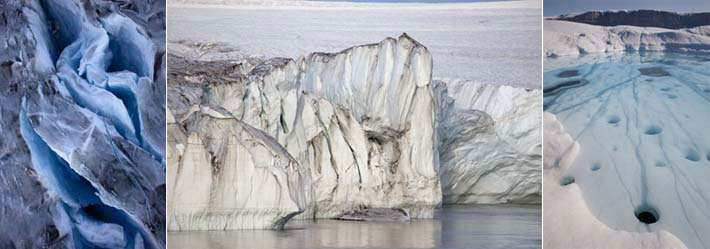
Left: Crevasses on the Kangerdlugssuaq glacier. Center: A calving front of the Humboldt glacier; this is where bergs calve into the Kane Basin in northern Greenland. Right: Cryoconite holes on the Petermann glacier in north Greenland. The black granular cryoconite accelerates melting because the darker part of the spectrum lowers the albedo or reflectance of the usually white ice. Photographs copyright and courtesy Nick Cobbing.
PR: Can you characterize the difference between being aboard the Arctic Sunrise versus the Noorderlicht (the hundred-year-old wooden sailing ship used on the 2007 Cape Farewell expedition that Nick reported on for DART)?
NC: The big difference is the thickness of the hull. Our somewhat epic journey on the Noorderlicht was spent dodging ice whereas my voyage this summer was spent crunching through it. Ships used for Polar work are classified according to their ability to negotiate different thicknesses of ice. The Noorderlicht is at the beginning of that scale and the Arctic Sunrise is closer to the middle, having a strengthened bow, a protected propeller and a shallower keel. While the Sunrise is clearly preferable in terms of getting through ice, she does have one disadvantage: she rolls violently from side to side in anything but the calmest weather and in a storm, she heaves up and down in a corkscrew fashion. A sailing ship with all its canvas raised can often be easier on the stomach.
PR: Were you sea-sick?
NC: Kind of, yes. It does get harder to work when the weather is choppy. During the worst weather, of the 30 crew and guests, only 4 weren't seasick, it became a very quiet ship!
PR: On your website, you mentioned being hoisted overboard into the subzero sea in a small boat and motoring up to those massive bergs. What was that like?
NC: The boats we used are rigid hulled inflatable with small inboard engines. They perform admirably but no inflatable boat is immune to damage from ice floes and bergs and this can be a problem as floes moved so quickly.
Being next to large bergs is humbling, and occasionally scary, as each creak can signal that the berg might be shifting its weight distribution in the water. A rolling berg can crush a ship from two directions depending on which way it rolls. At some point we made a collective decision about how close is safe to go; as a photographer, I naturally want to get closer to them.
PR: But what about the danger this presents?
The sea is very cold. I can attest to this personally as during some kayak training I fell in. Although I was wearing a dry-suit, the water seeped in around my neck and by the time I was fished from the water I was losing feeling in parts of my body.
PR: What did you come away with, from a personal standpoint?
NC: The trip reinforced my love of the Arctic landscape. This was my fifth trip to the region and each visit has added different layers to the experience. I think the first time I went there I was in shock, purely at the vastness of the landscape. More recently I've been able to focus on the details and features, aided by a certain familiarity and calmness that I've been able to develop with experience.
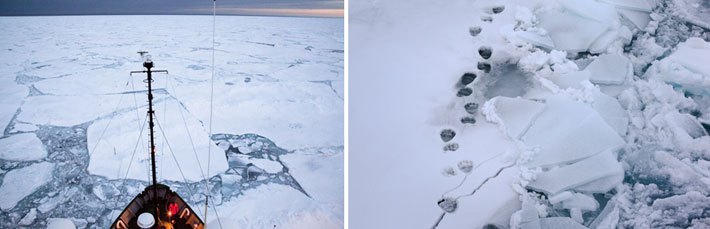
Left: View from the crow's nest of Arctic Sunrise. Right: Bear prints adjacent to broken sea ice in the Fram Strait, between the Norwegian archipelago of Svalbard and Greenland. Photographs copyright and courtesy Nick Cobbing.
The other thing that any visitor cannot fail to be aware of over time is climate change, and spending 101 days in the company of climate scientists I was no exception. To put it plainly, sea ice is melting and rapidly so in the summer months - much faster now than in the past. While we were on the trip, the National Snow and Ice Data Centre reported that the coverage of sea ice in the summer period was the third lowest since the start of satellite records in 1979 and that the past five years have seen the lowest amounts of ice coverage since satellite records have been kept.
Meanwhile glaciers on land are showing the effects of climate change too. GPS units placed on the glaciers during this trip show faster rates of travel and both the Helheim and Kangerdlugssuaq glaciers were moving ice masses towards the sea at exceptionally high speeds.
PR: Was there anything you hoped to take away from this voyage that you couldn't get for one reason or another?
NC: Photographs with snow engulfing the ship - but we didn't get any!
Visit Nick's website to view his Ice portfolio and commentary. Photos of the 2009 expedition can be seen here, here, and here.
121809 cobbing
Correction: In Wednesday's post I erroneously reported that the three remaining BauhausLab workshops were sold out. These programs are free and open to the public on a first-come basis. Please visit the website for information.