


The Urban Incubator: Belgrade
At this time of year many students, new graduates planning a gap year, and art faculty members are organizing for a summer residency program. And every spring, some of the most fascinating programs reveal themselves among the hundreds of announcements that land in my inbox.
The Urban Incubator: Belgrade [UIB] is my choice for a program to follow on a regular basis this summer. An initiative of Goethe Institut, UIBs mission is to support the re-vitalization of the now neglected Belgrade area of Savamala, formerly a charming district with Austro-Hungarian architecture and a number of cultural institutions.
Utilizing the well-known power of artists and activist cultural initiatives to reclaim downtrodden neighborhoods, UIB programs will enable the residents of Savamala and Belgrade to help shape the future of their city.
The website presents the program as follows: Situated on the southern bank of the river Sava in a neighborhood of the old town, Savamala was one of the most beautiful areas of the city. Savamala is rich both in tradition, history and heritage, which is visible in the many valuable historical buildings in the district. But world wars, authoritarian rule and the current economic crisis have left their marks.
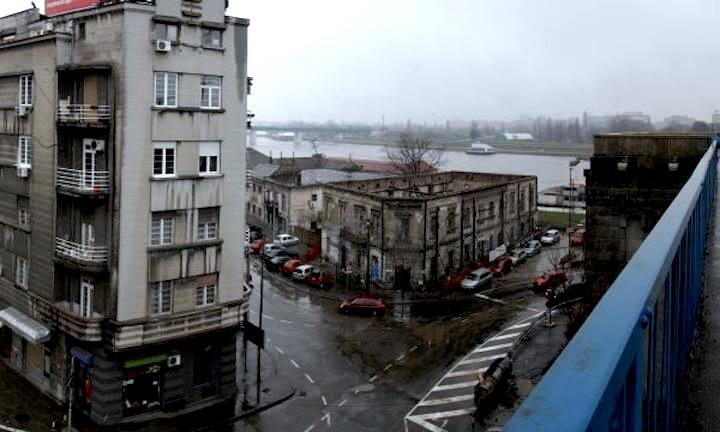
View of the Savamala district.
Today, Savamala is in a state of dilapidation, economically underdeveloped and socially disadvantaged. The Urban Incubator: Belgrade aims to improve the quality of life of local residents, arguing strongly in favor of a city on a human scale, and aims to encourage the residents of Savamala to take charge of their quarter….The Urban Incubator: Belgrade represents a participatory approach to urban development and could serve as a model for other cities in Serbia and the region.
Last week, Goethe Institut: Berlin hosted Welstadt, a one-day conference on alternative and participatory forms of architecture and city planning from around the globe. According to a report by Nathalie Janson in Uncube, the day unfolded as follows: Ten-minute presentations by panelists introduced the audience to a set of unique projects and contexts: the occupation of disused buildings in Riga [Latvia], the participation of rural migrants in the municipal planning of Ulan Bator [Mongolia], and urban interventions that have helped ease tensions between rural migrants and urban dwellers in Dakar [Senegal], to name a few.
Watch the raumlaborberlin video about Micro-Factories on YouTube.
Uniting the sometimes starkly different situations are the economic, social, and political changes that are profoundly altering cities today. At a time when city-building in the West seems an increasingly impenetrable process driven by crony capitalism, it is encouraging to view concrete examples of urban planning and architecture as something that is not “done to you and your communities,” but as a process that individuals can be a part of.
Ms. Janson’s report concluded: A deep distrust of political institutions and politicians was omnipresent at the conference, and with good reason. Representatives from Riga and Belgrade described their struggles and frustration with corrupt politicians and the lack of transparency in city governance. Yet while Serbians and Latvians have legitimate complaints about poor governance, it is unconstructive for the whole field to take that stance. Architecture and urban planning are not about choosing between “top-down” and “bottom-up”; they are about leveraging the strengths of both to create buildings, neighborhoods and cities that are viable socially, economically and ecologically, and, at best, that contribute to the visionary strategies necessary to tackle complex issues like global warming, migration and inequality — all cited as impetuses for the project. What Weltstadt shows, more than anything, is that communities can contribute to this struggle with just a little institutional support.
The next report in DART will focus on the lead design organization, raumlaborberlin, a collective of eight architects working to transform urban spaces through playful, political, and participatory interventions, and the Belgrade artists´ initiative Trei Beograd/Third Belgrade, which is creating a MediaLab to foster greater dialogue between Savamala’s artists and its longtime residents.