


Charles Lindsay's CARBON at CPW
A photographer, musician, and installation artist who originally trained to be a geologist, Charles Lindsay is fascinated by the aesthetics of scientific imaging and the great experiment that is life on earth. His work harnesses the organic, the sensory, and the mechanized to explore our perception of the universe and the evolution of symbols.
Currently on view at Center for Photography at
Woodstock is Lindsay’s CARBON project, realized using a hybrid camera-less process he invented. This imaging technique fuses mark making with photography through a unique carbon based emulsion
that he electrifies, freezes, and manipulates in many ways. The installation includes an interactive soundscape, which will redouble into a live multi-instrumentalist presentation this weekend in
Woodstock, detailed below.
I saw the show over Thanksgiving weekend, and caught up with Charlie for this Q&A afterwards:
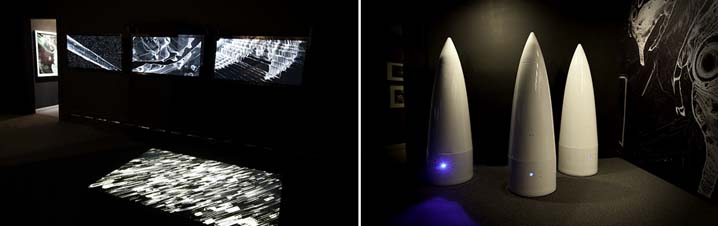
Left: Installation view of CARBON. Right: Projectiles, three interactive sculptures, salvaged F-16 fighter jet fuel pods, audio players, custom audio response circuitry, motion detectors, LED strobe lights. Photos copyright and courtesy Charles Lindsay.
Peggy Roalf: What were you working on and what were the circumstances that inspired you to make the camera-less images that led to your Carbon series?
Charles Lindsay: The initial discovery of the CARBON process came at a time when I was experimenting with photograms of water. This closely followed the underwater photography at the tail end of Upstream (Aperture, 2000) when I became fascinated with the interaction of light and water in Rocky Mountain streams. Back in the darkroom I was surprised when some apparently two dimensional paint marks on glass, graffiti remnants from a service elevator on Canal Street in New York, appeared in three dimensions through the photographic transformation. The potential was incredibly exciting. I invented emulsions, tested grounds, and made silver gelatin prints from selected areas within the giant negatives. The carbon based emulsion which I first developed offered greater resolution and tonal scale than even the most fantastically detailed mammoth plate photographs made by Carlton Watkins, which I’ve long admired. But that is just about technique. The world that has come to be through the CARBON process has been amazing, and I want to be amazed. I’m an explorer at heart.
PR: What were some of the high points of the time you spent as Artist in Residence at SETI last summer? For example, what did you learn from the astronomers and scientists that directly figured into this iteration of the CARBON series?
CL: The SETI Institute’s mission is to explore and illuminate the origin, nature and prevalence of life in the universe. The Institute’s A.I.R. program seeks to encourage a cross pollination of ideas between scientists and artists. My time at SETI has been one sustained high point. I was there earlier this year when Laurance Doyle discovered a planet in a distant solar system that orbits a pair of stars known as Keppler A and B. Laurance has also researched diverse animal communications in an effort to imagine how alien species might communicate. The audio aspect of my art is being directly influenced by thinking about such things.
Peter Jenniskens, based at The SETI Institute, is the principal investigator of NASA's Leonid Multi-Instrument Aircraft Campaign that fielded modern instrumental techniques to study the Leonids meteor storms. These missions helped develop meteor storm prediction models, detected the signature of organic matter in the wake of meteors as a potential precursor to origin-of-life chemistry, and discovered many new aspects of meteor radiation. Peter is very interested in imaging and how the public understands scientific imagery. He also knows a lot about art. I’ve learned a great deal from conversations with him. The planetary Astronomer Mark Showalter provided several gigabytes of Cassini Mission imagery, of Saturn’s rings, moons and visualized data. I’ve constructed videos interpreting and abstracting that data both for the ‘Rocket Brain’ sculpture’s internal android tablet and for some of the Trout Fishing in Space live show visuals. Those are just three of approximately 130 incredible scientific minds based at SETI. And they have without exception embraced the idea of having an artist amongst them.
PR: What’s the strangest place you’ve gone to for your sound captures? What’s the most ordinary sound you’ve collected that turned out to be surprising and useful for the program?
CL: One of my great pleasures in life is collecting audio recordings in the wild. And I am a lover of strange places. Night diving in Indonesia has taken me to the weirdest environments I know of. The giant lava tubes at Craters of the Moon National Monument in Idaho are wonderful, covered with orange and green lichen, providing fascinating acoustics with crystalline sounds from the obsidian shards. But the rain forrest in Costa Rica where my wife Catherine Chalmers and I have been working is the best. Its one of the most bio-diverse places on earth. Absolutely bizarre, complex and really loud. For ordinary sounds, the honk of a goose can be turned into so many things !!
I love nocturnal environments and like to work within that realm. The Center for Photography at Woodstock painted their entire space black and laid dark carpet to accommodate my show. I very much appreciate their willingness to go with the idea to that degree. Great folks.
PR: Projectiles, one of the pieces in the current installation at Woodstock, repurposes some really slick F-16 fighter jet fuel pods to accommodate the audio mechanisms for CARBON. How much access did you have to NASA leftovers for your work when you were at SETI? What were some of the cool items that you had to leave behind?
CL: SETI’s relationship with NASA Ames has begun to provide some interesting opportunities for acquiring space salvage to re-purpose. That process is just getting going but can be quite bureaucratic, so its a good thing the residency goes until spring 2013. I was jones-ing for a skeletal back-up space station module that was at Johnson in Texas, but the transportation costs would have been prohibitive. The F-16 parts actually came from an aerospace salvage yard in L.A. and the ‘Rocket Brain’ is built from a 1970’s missile guidance system I purchased on Ebay. I don’t want to amass junk, so anything that doesn’t seem destined for an actual piece gets photographed and left where it is. Space suits and radar gauges get left behind. Anybody want to buy some 1960’s ECHO II mission tapes?
PR: I understand that you are expanding on the sonic components of CARBON in the coming year. What will you be working on, and where?
CL: My sonic universe is expanding in all directions. I’m learning ever more about software processing, inter-active applications, spatial delivery systems and audience receptivity to sound installations. This field is growing quickly and collaborations are common, which I like. I am hoping to create a piece in the giant wind tunnel at NASA/Ames next year. I’m working on a CARBON based planetarium dome projection with 7.1 surround sound. That will debut in September, 2012 in Santa Fe at the Institute of American Indian Art in the New Mexico wide Getting off the Planet show.
PR: Your work covers a broad spectrum, from being a geologist in the Arctic to photographically documenting the Mentawai tribe of Indonesia. How did you get interested in life beyond the anthropocentric sphere?
CL: I’ve been very fortunate to figure out ways to explore my fascinations for almost 30 years. My education in geology led to work in the arctic and to photography. That led to anthropological (too clinical a term for what I did) and environmental photojournalism. In hindsight it seems I’ve tried to experience everything in one lifetime, just in case reincarnation is a myth. I’m most interested in the web of life on earth and in consciousness, and that logically leads to considering what is beyond us. This is a magical time for science. The gap between science fiction and science reality has become slim. The scientific realm is where the possibilities for sustaining human existence will come from. We are very early on the evolutionary curve. I’m an optimist, I hope we’ll survive a long time.
PR: What’s next for you at SETI and elsewhere?
CL: The artistic vein I’m working in is rich and Silicon Valley is an exciting place to be. I’ll be continuing to explore ways to present my vision through new media. Of real importance will be for The SETI Institute’s Artist in Residence program to develop a strategic plan, long term funding and global awareness. I hope my work reflects favorably on those initiatives. The possibilities for inventive artists will be incredible. Who knows what might arise? The next recipient will be announced spring 2013.
CARBON continues at The Center for Photography at Woodstock through January 29th. Trout Fishing in Space is a live music and video performance being presented on December 10th debut at the Byrdcliffe Kleinert/ James Arts Center as a companion to CARBON. Tickets. This show will include original electronic and acoustic music performed by five internationally renowned musicians to original video. Information.
Charles Lindsay is the SETI Institute’s first Artist in Residence. His career trajectory has been diverse, ranging from exploration geology in the arctic to photojournalism in the jungles of southeast Asia. Lindsay’s environmental work has appeared in numerous international magazines and has been profiled on NPR, CNN and NHK Japan. He has published seven books of photographs.
In the last decade Lindsay has created an immersive installation project called CARBON. At the heart of CARBON is a unique camera-less photographic process the artist invented and for which he received a 2010 Guggenheim Fellowship. Lindsay works with very large photographs, video animation, multi-point sound and inter-active sculptures built from salvaged scientific devices and space equipment. He is also a musician, mixing electric cello with audio recordings he captures in diverse eco-systems all over the planet.