


Manipulating the News: How to Prevent It
Not Only Photoshop: Manipulating the News and How to Prevent It. This is the title of a panel held by the Metropolitan Museum of Art last night, with top media people at the table: Margaret Sullivan, Public Editor, the New York Times; Tom Kent, Deputy Managing Editor and Standards Editor, Associated Press (AP); Adam Rose, Senior Editor and Standards Editor, the Huffington Post; moderated by Bill Goldstein, former founding editor of the books site of nytimes.com, currently book critic for NBC’s “Weekend Today in New York.”
The discussion got off to a lively start, propelled by the fact that the Associated Press Twitter feed had been hacked earlier in the day; an erroneous report that the White House was hit by 2 bombs and the president had been injured went out and went viral. The stock market briefly plunged by 250 points. Mr. Kent said that the report was immediately debunked by AP because no news organization could possibly report both events (the bombs, the injury) simultaneously.
The panelists then discussed Twitter as an important, if often unreliable, tool of the trade, and how to use it to advantage. Available to anyone with an Internet connection, anywhere in the world, Twitter is the fastest way of communicating today. All on the panel agreed that it’s a channel, not a reporting tool; and you must rely on reliable sources on the ground. Mr. Kent said, “ Its like the first rule of mountain climbing: Never look down; you have to look for the next good hand hold and keep moving up.”
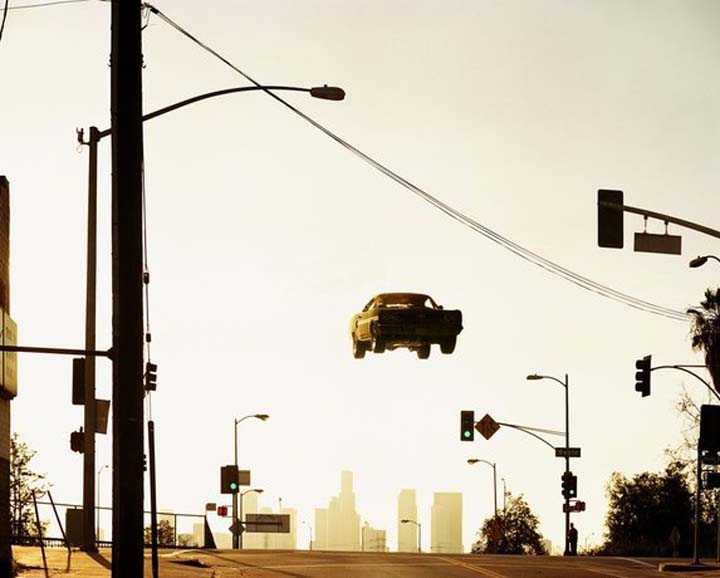
Above: Matthew Porter, 110 Junction, 2010, included in the exhibition, Photoshop: Manipulated Photography in the Digital Age, which continues at the Met through May 27th. Note: this is the image displayed during the panel discussion reported here.
Mr. Rose pointed out that Twitter represents the democratization of news, which can be a good thing, as during the Arab Spring, in Tahrir Square. Mr. Kent cautioned that the news process has three essential aspects: gathering information; verifying and contextualizing the information; and disseminating the information. “Twitter is good at either end of the spectrum but extremely fuzzy in the middle,” he said. “Anyone can collect and disseminate information but it takes a seasoned journalist to provide the necessary context.”
A large part of the discussion concerned the speed at which information travels today and the high rate of misinformation that results. The Boston Marathon bombing and the Newtown school shootings were the main subjects around which this discussion revolved. All agreed that the likelihood of factual reporting in the early hours of any disaster is low, with examples of mistaken identity, location, and participation more the rule than the exception. "Even official statements can be wrong at the outset," Mr. Kent said. "You can be left with a sense of desperation, not being able to believe anything that you hear."
Ms. Sullivan pointed out that during TV news coverage of the Marathon bombing, there was basically too much air time allowed during the hours immediately following the disaster, also during the subsequent manhunt, considering the lack of solid information available. She said that Pete Williams, reporting from Washington, D.C. for NBC News, was alone in offering reliable information in a calm voice. “He was the only one who got it right.” The panelists agreed, with additional comments on the fact that incorrect information was being gathered straight off police scanners, heard blaring around the site of the stakeout, and which are considered the most unreliable of all sources because the information is absolutely unedited.
The question of AP as a media outlet came up; Mr. Rose explained that the organization, which used to be a wholesaler of news, was now in the business of reporting, with a mobile app for other media outlets to select reportage to publish. He allowed that following the Marathon bombing, AP also made mistakes, “but we did it the old fashioned way,” he said, “by using information from an unreliable source. We’ve been right for a long time, because we ask if it’s correct, and we generally wait until we know what’s true. We have no ethical reason for pushing beyond the barriers.” All agreed that it was essential to never use unnamed sources, because these are “individuals who have no stake in getting it right.” Ms. Sullivan pointed out that during the early hours following the Newtown shootings, most news organizations all made “the worst mistake that you can make” by picking up the erroneous report by CNN identifying the shooter as the brother of Adam Lanza, who was, in fact, the shooter.
Mr. Goldstein led a brief discussion about the temptation to jump to conclusions due to the speed at which information travels. “There’s an idea that a free market on information exists. Because of the intense competition between media organizations, some feel that there’s no need to have a filter; every piece of information is valuable; when the loudest one gets reported, and it turns out to be false, that’s the price paid for a free market.”
Following a discussion of the definition of what constitutes a news photo, the panelists concluded with a conversation, led by Mr. Kent, that “most people in journalism do it because they care; not for the paycheck. There are people behind each article who are passionate about finding the truth—and making it available.” In addition, he said that during a major emergency, most media outlets are now dropping their paywall; this was evident following the Marathon bombing when the New York Times and the Boston Globe made their online editions universally available. “So much of the conversation [we are having here tonight],” he added, “continues on a daily basis; we make very conscious decisions and do our best; sometimes we make mistakes but more often we get it right.”
A lively Q&A followed.
From the floor: “What do you do when you realize that someone you are covering, such as a politician, is telling outright lies.” Mr. Rose said that AP fact checks and generally will report the statement made followed by a disclaimer that includes the facts. “If the pol keeps repeating the same story, eventually we stop covering him.”
In response to an earlier discussion about selectivity in distributing news photos of horrific events, an extremely well-informed member of the audience pointed out that “a photograph can only frame a selection of the world before the camera, so in a sense every photograph taken, whether by a pro or an amateur, is cropped.” Mr. Rose added that there is, indeed, a fine line between manipulating a photo through cropping versus the point of view of a photographer.
The Q&A concluded with a discussion about clearly identifying a photo illustration so that it will not be mistaken for a news photo. The photo under discussion was one of the swearing-in of a record number of women Democrats to Congress last January.
This panel discussion was organized in conjunction with the exhibition After Photoshop: Manipulated Photography in the Digital Age, which continues through May 27th. Information. The Metropolitan Museum of Art, 1000 Fifth Avenue, at 82nd Street, NY, NY. Information.
The Museum presents a wide variety of lectures, panel discussions, concerts, performances and gallery tours, both free and ticketed. On Thursday, May 9, Paul D. Miller (a.k.a. DJ Spooky), the Metropolitan Museum’s current Artist-in-Residence, and author/environmentalist Bill McKibben, will talk about climate change. Information. On Tuesday, May 31, DJ Spooky returns for a discussion, Documenting War, with photographer Susan Meiselas and Jeff L. Rosenheim, Curator in Charge, Department of Photographs, Information, in conjunction with the exhibition Photography and the American Civil War. Information. All ticketed talks. All free lectures. All public programs.