


The Girlfriends of Christer Stromholm
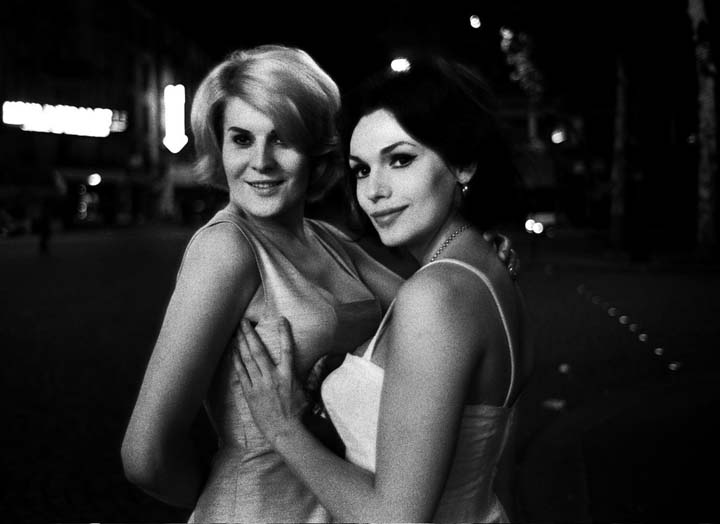
Christer Strömholm (1918-2002), known as the “father of Swedish photography,” has remained until recently virtually unknown outside of Europe. Trained as a painter, he took up photography at the age of 40. According to a 1980 article in Camera (Magazine), he eventually found painting to be too static; he sought a more descriptive form of reality outside of the studio, which photography offered.
In the late 1950s, he began making pictures of people living on the fringes of society, photographs that express his view of the tragic and imperfect side of life. According the Camera article, Christer (as he is known in photography circles) worked in obscurity, compiling an enormous body of work. “He has a collection at home which [everyone talks about but which] nobody has ever seen…that bears some relation to a surrealistic scenario.” Christer’s work, the article continues, could be compared to an obsessive long-term study by an artist, and reveals that the meaning of photography for him is the equivalent of keeping a journal about the meaning of life. The title of his 1980 exhibition in Stockholm, was, in fact, “Memories of Myself.”
Now his 10-year documentation of transsexuals, Les Amies de Place Blanche (Girlfriends of la Place Blanche), first published in 1982 (20 years after it was shot), has been re-shaped in a French and English edition, being released in conjunction with an exhibition at the International Center of Photography.
At a symposium held at ICP last Friday, the world of Christer’s Place Blanche was revealed through a panel that included his son, Joachim Strömholm, director of his father’s archive; Vincent Marcilhacy, publisher of the new volume; curator Pauline Vermare; and Jacky, one of les amies. The photographer befriended this community of young transsexuals who worked the streets to raise money for sex-change operations; he returned every few months to share their daily lives in this closed world as a friend and collaborator. Set in the red-light district of Paris and shot in the neon glow of cabarets such as the Moulin Rouge and the Sphinx, Christer’s photographs capture the swirling night life of this carnivalesque neighborhood.
The 1982 version of the book, published in an edition of 1,000 copies, quickly sold out and, as far as the audience for photography in America was concerned, remained pretty much invisible. At the time, the subject matter was still part of an unspoken underground, a shadow world that was repressed and whose occupants were constantly harassed by the authorities. The Camera article points out that Christer’s work is akin to a research study in which “a totally unknown race is brought to light. Nevertheless, these are people who live amongst us in all major cities.”
But Christer’s friends were a glamorous lot whose femininity, high-style fashions, hairdos and makeup made them quintessentially female. When looking through the book, what you see is a cast of charismatic stars that seems to have emerged from a Fellini set. When the photographs were shown as part of a 1980 exhibition of Christer’s work, held in a gallery within a Stockholm department store, it wasn’t until the show was up for three days that the organizers realized that les amies were not what they had thought; the photographs were immediately taken down.
Christer followed several of the friends through their gradual transformation from male to female. As a witness to their world but never a voyeur, he created a lush and sensitive album that was, as he wrote, “about obtaining the freedom to choose one’s own life and identity.” The difficulties of being constantly arrested, which Jacky said she was, and not being able to find work beyond the hustle, made for anxiety and melancholy under the repressive de Gaulle regime. One of the most glamorous of the friends, for example, was approached by Vogue magazine for a modeling assignment; without an ID that matched her appearance, however, she could not take the job.
Comparisons between the work of Christer Strömholm and Diane Arbus are inevitable, but the images could hardly be more different in approach. While both photographers were intrigued by people living beyond the margins of society, Arbus’s cold eye has the effect of distancing her subjects from the viewer; Christer’s empathy with his subjects does quite the opposite. Perhaps because he returned often to Place Blanche over a long period of time, he was able to encapsulate a drama that unfolds gradually in the pages of the beautifully printed book.
Christer Strömholm | Les Amies de Place Blanche includes vintage prints, contact sheets, letters and ephemera and continues at the International Center of Photography through September 2. Information. The book (Aman Iman, 2011) is available at the ICP Bookstore. Above: Christer Strömholm, Gina & Nana, 1963) © Christer Strömholm / Strömholm Estate.
05222012